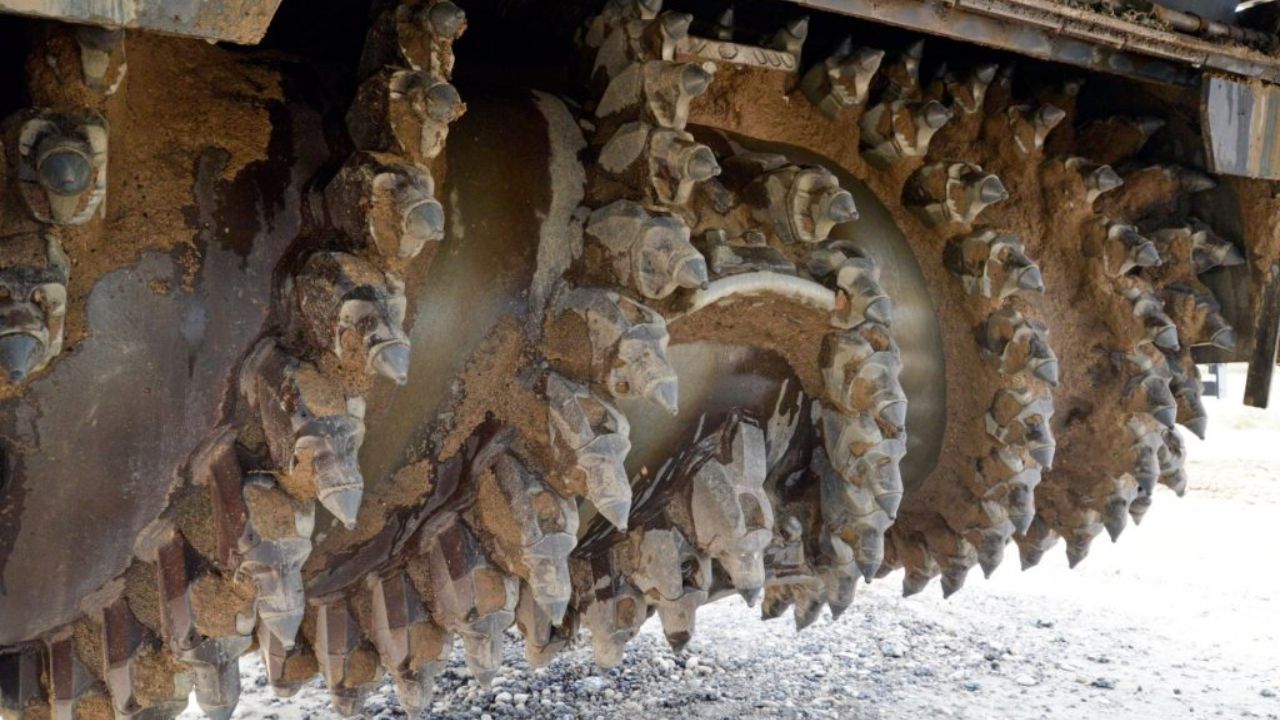
When bits are failing faster than they should on a continuous miner, the conversation usually goes to carbide grade, supplier quality, or penetration rate before it goes to rotation. That’s backwards. Bit rotation is the primary determinant of service life for conical bits, and a bit that isn’t rotating correctly will wear out in a fraction of its normal life regardless of how good the carbide is. Before changing bit specifications, it’s worth confirming whether the bits in the cutterhead are actually rotating the way they’re supposed to.
Why Rotation Matters More Than It Seems
A conical bit’s service life is built around one assumption: that the bit rotates continuously in its holder, distributing wear evenly around the full circumference of the carbide tip. When that happens, the tip maintains a symmetric point geometry throughout its wear cycle, stays sharp, and cuts efficiently up until the point where the carbide is worn to discard size.
When rotation stops — or never starts properly — the bit develops a flat on the leading face. That flat changes the cutting geometry from a point that exploits fracture planes in the coal to a blunt face that has to push through material rather than cleave it. The cutting force required goes up, heat generation at the tip goes up, and the wear accelerates because the blunt geometry produces abrasive contact on a fixed face area instead of rotating contact distributed around the tip.
The flat can develop within a few shifts of a blocked holder. An operation that’s seeing unusually short bit life and attributes it to carbide quality often has blocked holders as the underlying cause. The bits are failing from geometry loss, not from soft carbide.
What Blocks Holder Rotation
The most common cause of blocked rotation is fines packing into the holder bore. Coal fines and clay-bearing material from the seam floor or roof can migrate into the annular gap between the bit shank and the holder bore during operation. As the fines compact, they wedge the bit in place and prevent it from rotating even when the cutting force distribution would otherwise spin it.
Holder bore cleanliness at bit change is the primary control for this. Bits pulled from holders that are packed with compacted fines need a clean holder before the replacement bit goes in — otherwise the new bit starts in a blocked condition and never rotates from the first shift. Compressed air to clear the bore, a bore brush if the packing is heavy, and a visual check to confirm the shank rotates freely before the bit is seated. This takes an extra minute per holder and is skipped on most machines because there’s time pressure on bit changes.
Holder wear is the second cause. As holders log production hours, the bore diameter increases through wear at the upper shank contact zone. A worn holder lets the bit shank run eccentric rather than centered, and the eccentric contact reduces the asymmetric force distribution that drives rotation. Old holders can also develop burrs or impact damage at the mouth of the bore that grip the bit shank mechanically and prevent rotation even if the bore itself is within spec.
Holder condition should be checked whenever a bit fails early or shows flat-wear on the tip at removal. If the holder bore is oversized or has mechanical damage, replacing the holder resolves the rotation problem. Putting a new bit in a worn or damaged holder produces the same premature failure.
Reading the Wear Pattern at Removal
Pulled bits tell you whether rotation was occurring during service. A bit that rotated correctly shows circumferential wear on the carbide tip — the wear surface is symmetric, and the tip retains its point geometry in cross-section even as it wears down. The bit looks like a smaller version of a new bit, not a distorted one.
A bit that ran without rotating shows a flat or lobe on the carbide tip — the wear is concentrated on the face that was consistently presented to the coal, and the geometry on the opposite side is relatively unworn. In cross-section, the tip is lopsided: one zone heavily worn, the opposite zone intact. This is the flat-wear signature of a blocked or sluggish holder.
Pulling a sample of bits at change-out and checking the tip geometry is the fastest way to assess whether rotation is occurring across the cutterhead. If more than a small fraction of the pulled bits show flat-wear, the holder condition across the head needs to be evaluated — a pattern of flat-wear on multiple bits typically points to systematic holder issues rather than individual blocked holders.
The Operating Conditions That Affect Rotation
Beyond holder condition, operating parameters influence whether bits rotate adequately in service. Bit rotation is driven by the asymmetric loading that occurs when the point contacts material at an angle — the force distribution around the tip creates a net torque that spins the bit. At very low penetration rates, this torque may be insufficient to overcome the friction in the holder, and bits can run partially engaged without developing the contact force needed to rotate.
Hard seams require higher cutting force to penetrate, which generally improves rotation because the higher contact force creates more torque on the bit shank. Soft seams at low machine penetration rates are more likely to produce rotation problems, particularly if the holders are slightly worn or have some residual fine packing.
Water flushing during cutting helps in some conditions — the water keeps fines mobile and reduces the rate at which they pack into holder bores. Operations with good water flushing systems typically see fewer rotation problems from fine packing than dry-cut operations in the same seam, all else equal.
Establishing a Holder Inspection Routine
The practical response to bit rotation problems is a regular holder inspection that catches degradation before it affects production. At each bit change, checking bore cleanliness and bore diameter against a go/no-go gauge takes less time than a premature bit failure investigation. Holders outside diameter tolerance get replaced at that change rather than running until the bit life problem prompts a deeper look.
For operations dealing with chronic short bit life that hasn’t responded to changes in bit grade or specification, investigating holder condition is the first step — not the last one. Operators looking for more context on how bit selection and maintenance practices interact in coal mining applications can learn more from JYF Machinery about the factors that affect continuous miner bit performance in practice.
Building the habit of reading pulled bit wear patterns creates institutional knowledge about what the seam is actually doing to the tooling. It also catches the rotation problem early — a few bits with flat-wear flagged at one change-out is a holder maintenance reminder; a full cutterhead of flat-worn bits at the next change-out is an avoidable loss that a check at the previous change could have prevented.